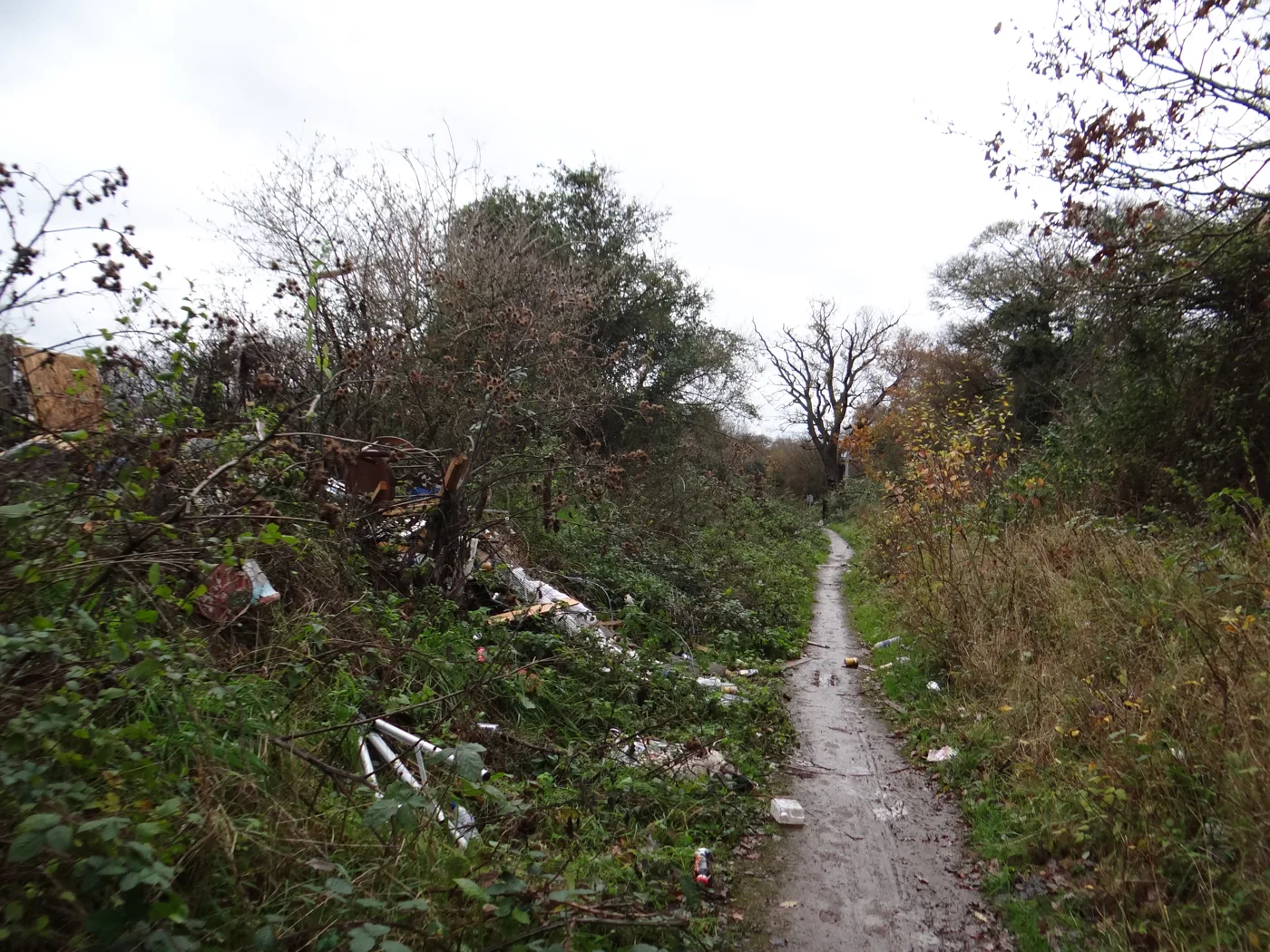

Worcester logged 512 fly-tips in 2024/25, the most in 13 years of Defra records, but issued 7 fines and no prosecutions. Where it happens and how to report it.
Worcester City Council dealt with 512 fly-tips in 2024/25. That is the highest number in the 13 years the government has published council-by-council figures.
Over the same year the council issued 7 fixed penalty notices for fly-tipping. It seized no vehicles and brought no prosecutions.
The figures come from Defra’s ENV24 fly-tipping tables, which every council in England reports into. The latest release, published on 25 February 2026, covers April 2024 to March 2025. The 2025/26 figures are not due until early 2027.
Updated 15 October: the council has launched a city-wide push for national Fly-tipping Fortnight, which runs from 12 to 25 October. Its staff will visit communities to talk about fly-tipping and its bulky waste collection service, and officers say they will consider enforcement, including fines and prosecution, against any fly-tipping they find on those visits. The council also reminded residents that a householder can be prosecuted if dumped waste is traced back to them and they cannot show it went to a licensed waste carrier (Worcester City Council).
Up by half in two years
Worcester’s count had been fairly steady for a decade, mostly between 300 and 450 a year. It then rose two years running:
- 340 in 2022/23
- 432 in 2023/24
- 512 in 2024/25
That is half as many again in two years. The previous high was 501, in 2014/15.
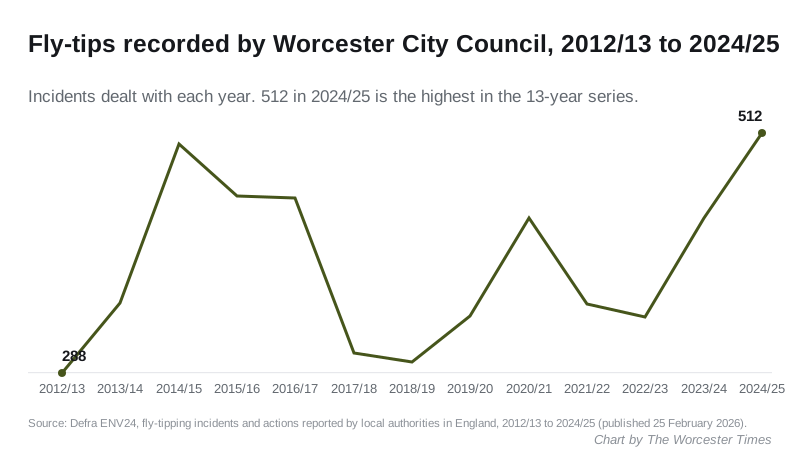
England as a whole went up too. Councils dealt with 1.26 million incidents in 2024/25, a rise of 9% on the year before, according to Defra’s statistical release. Worcester’s one-year rise was steeper, at about 19%.
Still one of the cleaner places in the county
Worcester’s rise starts from a low base. Defra puts the city’s rate at 4.8 fly-tips per 1,000 people, against 21.5 for England and 16.2 for the West Midlands.
Across Worcestershire’s six districts in 2024/25:
| District | Fly-tips | Per 1,000 people |
|---|---|---|
| Malvern Hills | 298 | 3.6 |
| Worcester | 512 | 4.8 |
| Wychavon | 948 | 6.9 |
| Wyre Forest | 831 | 8.0 |
| Bromsgrove | 1,591 | 15.6 |
| Redditch | 2,255 | 25.7 |
Only Malvern Hills recorded a lower rate. Defra warns that councils use some discretion in how they record incidents, so a high count can partly reflect a council that logs more thoroughly. Comparisons between councils need that caveat.
Where it was dumped
Footpaths and bridleways were the most common place, with 183 incidents. That is more than a third of the total, and the highest footpath figure in the city’s series. The rest of the main locations were:
- council land: 123
- roads and verges: 95
- private and residential land: 46
- back alleys: 37
Most of it was household rubbish. “Other household waste” accounted for 258 incidents and household black bags for 62, together about six in ten of the total. That matches the national picture, where Defra says 62% of fly-tips involved household waste.
Smaller categories included 30 loads of building rubble, 28 fridges, freezers and other white goods, 20 other electrical items and 15 piles of garden waste.
Size matters for what it says about who is doing it. In Worcester:
- single black bags: 38
- single items: 119
- a car boot load or less: 147
- a small van load: 138
- a transit van load: 70
Van loads made up about four in ten of the city’s fly-tips. That is the scale of a paid “man with a van” clearance or a building job, not a resident leaving a bag by a bin.
What the council did about it
The council recorded 380 enforcement actions in 2024/25. Almost all were investigations:
- 351 investigations
- 21 warning letters
- 7 fixed penalty notices for fly-tipping
- 1 duty of care inspection
- 0 fixed penalties for household duty of care
- 0 vehicles seized
- 0 prosecutions
Fixed penalties have been in single figures or the teens for years. The council issued 10 in 2021/22, 17 in 2022/23, then 7 in each of the last two years.
The council’s environmental enforcement page sets a fly-tipping fixed penalty at between £150 and £400. Anyone who does not pay can be taken to court. Its fly-tipping page says offenders can be fined up to £50,000 or jailed for five years, and that it will prosecute “where sufficient evidence is available”.
The figures do not say how much clearing up cost. Worcester did not report clearance costs to Defra for 2024/25.
What it means for you
Report it on public land. The city council clears fly-tipping from public land, roads, verges, footpaths and bridleways. Use the online form on its fly-tipping page or call customer services on 01905 722233.
Private land is the owner’s problem. The council will not clear waste dumped on private land. If it is a health hazard, the council says to call Worcestershire Regulatory Services on 01905 822799. If it blocks a road, report it to the county council’s highways team.
If you see it happening, the council asks you to note the vehicle registration, a description of the people and what was dumped. Do not approach them.
Check who takes your rubbish away. Van loads are the biggest share of Worcester’s fly-tips. If you pay someone to clear a house or garden, ask to see their waste carrier registration first. The council can fine a carrier who cannot produce one £300.
For your own rubbish, see our pages on Worcester bin collection days and tip opening times.
Have your say