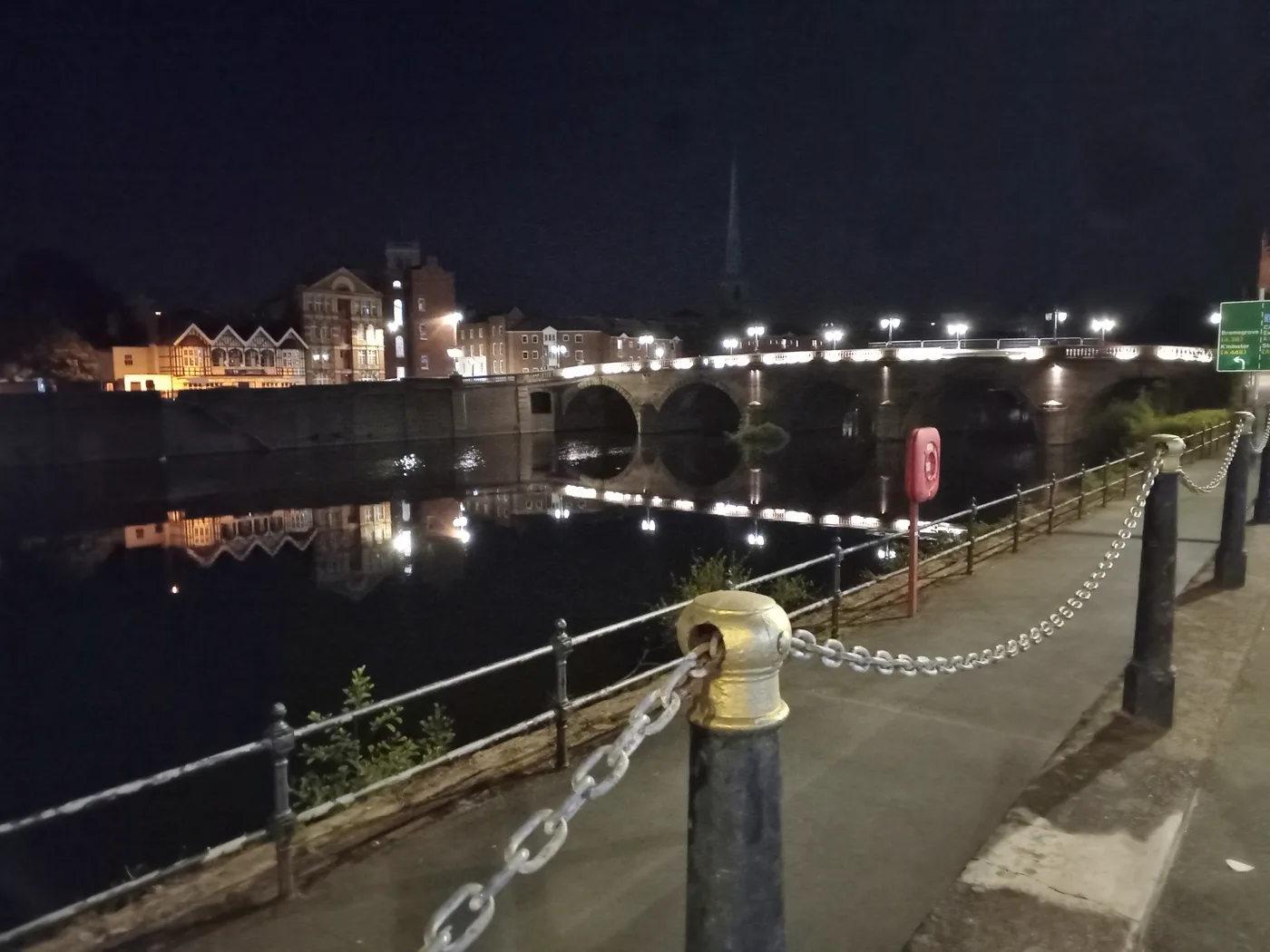

Worcester Bridge is down to one lane until about 9 November while masons repair the stonework a police car damaged in March. The pavement stays open throughout.
Repairs to Worcester Bridge started on Monday, seven months after a police car hit it. One lane of the city’s central river crossing is closed while the work goes on.
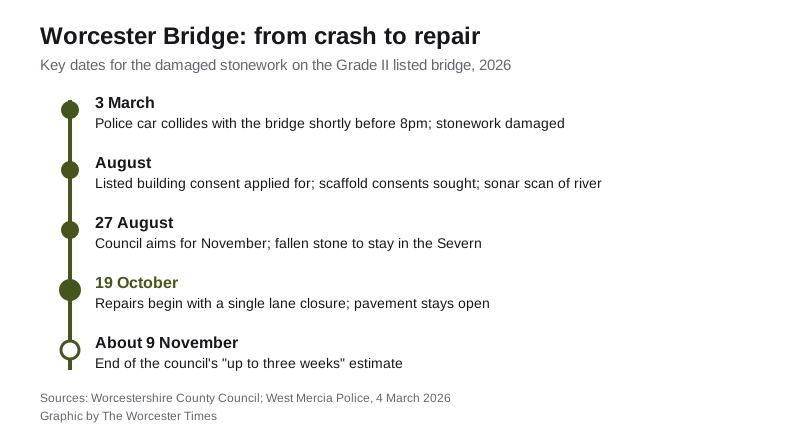
Worcestershire County Council says the work will take up to three weeks. Counted from Monday 19 October, that runs to about 9 November. The pavement across the bridge stays open throughout. (Worcestershire County Council, Worcester Bridge repair)
What is happening on the bridge
The council’s update for October says:
- work began on 19 October, with a single lane closure in place
- masons are repairing damaged areas of stonework
- sections that cannot be saved are being replaced with new stone chosen to match the old
- the job is expected to take up to three weeks
- pedestrian access stays open for the whole period
The council warns that drivers “may experience delays, particularly during peak travel periods”. It asks people to allow extra time for journeys through the city centre and to use other routes where they can. Its page does not say which side of the bridge the closed lane is on.
How the bridge was damaged
The damage dates from the evening of Tuesday 3 March. West Mercia Police said a police car “collided with Worcester Bridge shortly before 8pm”. The officers were on their way to an incident. (West Mercia Police, 4 March 2026)
The force said no one was hurt. It corrected its first statement, saying there had been no second vehicle involved. It also said its Professional Standards Department had been informed. At the time, one side of the bridge going into the city stayed closed while the council made the footpath and road safe.
Why it took seven months
Worcester Bridge is Grade II listed. Historic England’s entry records that it was built in 1771-80 to a design by John Gwynn of Shrewsbury, and widened in 1931, with stone balustrades along both sides. (Historic England, list entry 1063923)
That listing is why the repair could not be quick. The council’s updates set out what had to happen first:
- Listed building consent. An application went to Worcester City Council. The council said the repair would use “the same profile, dimensions, and detailing as the original structure”.
- Scaffolding consents. Applications went to the Environment Agency and the Canal and River Trust, because the scaffold has to sit over the Severn.
- A sonar scan of the stone that fell into the river, to decide what could be saved.
- Sourcing stone. The council said the lead time to find specialist stone, and prepare it to match, was “a key factor in the programme”.
In August, the council was aiming for a November start. The work has begun a few weeks earlier than that.
The stone in the river stays there
Some of the bridge’s masonry fell into the Severn. The council has decided not to recover it.
Its surveys found that much of the fallen stone was probably damaged, like the loose stone left on the bridge. It said the debris poses no risk to river users or to the bridge.
Lifting it out would have been expensive. It would also have needed specialist lifting gear, and the council said the bridge would have had to close for several days while that was done. Original stone is being reused where it is still sound. New stone goes in where it is not.
What it means for you
- Driving: expect queues on the bridge until about 9 November, worst at rush hour. Worcester has few river crossings: the A4440 Carrington Bridge to the south is the main alternative. Our Worcester roadworks page has the other closures in the city this week.
- Walking: the pavement stays open, so the route between the city centre and St John’s on foot is unaffected.
- Buses: services that cross the bridge may run late at peak times. The council has not announced any diversions.
Sources
- Worcestershire County Council: Worcester Bridge repair, updates from August, 27 August and October 2026
- West Mercia Police: Investigation continues following collision involving police vehicle, 4 March 2026
- Historic England: Worcester Bridge, list entry 1063923
Have your say