
The new table takes effect from 20 August if no objections stood. Both tariffs rise: £4.30 to £5.00 by day, £5.50 to £6.40 at night and on Sundays.
Worcester’s hackney carriage fares are due to go up today. The city council’s statutory notice names 20 August 2026 as the date the new table of fares takes effect, and the window for objections closed yesterday. (Worcester City Council, Section 65 notice, Variation of the Table of Fares for Hackney Carriages, published 5 August 2026)
The notice also settles a question the council’s own papers left open. Both tariffs go up, not just the daytime one. The committee that approved the consultation was shown a draft table that left night and Sunday fares completely unchanged. The notice that actually went out to the public does not.
We reported the proposal on 13 August and said we would publish the statutory figures and the deadline when the notice appeared. This is that follow-up.
The new table of fares
Tariff One covers 7am to midnight, Monday to Saturday. Tariff Two covers midnight to 7am, all day Sunday, all bank holidays, Christmas Day, Boxing Day and New Year’s Day, and the evenings of Christmas Eve and New Year’s Eve.
| Charge | Since May 2022 | Under the notice |
|---|---|---|
| Tariff One, first 1,208m (the flag fare) | £4.30 | £5.00 |
| Tariff One, first mile | £5.00 | £5.60 |
| Tariff One, each subsequent mile | £2.00 | £2.00 |
| Tariff Two, first 1,208m (the flag fare) | £5.50 | £6.40 |
| Tariff Two, first mile | £6.30 | £7.10 |
| Tariff Two, each subsequent mile | £2.80 | £2.80 |
| Waiting time, per 30 seconds, both tariffs | 10p | 10p |
The mileage rates do not move. Neither does waiting time, at 10p for every 30 seconds. The extra charges are also unchanged: 50p for each passenger beyond the first three, and £75 if a passenger or an animal soils the vehicle and it needs cleaning.
So the whole increase sits in the initial hiring charge, the figure on the meter before the car moves. That is deliberate. The trade asked for the flag fare alone to go up, and left the mileage rate where it was.
The May 2022 figures come from the council’s own fare comparison attached to the June committee report. The August figures come from the statutory notice.
The night fare the committee’s papers said would not change
This is the part worth knowing about, because the published record contradicts itself.
The June committee report says at paragraph 2.7 that the trade agreed to raise both flag fares. Tariff One would go from £4.30 to £5.00, and Tariff Two from £5.50 to £6.40. The report calls each of them “a 16% increase rounded down”.
The draft table attached to that same report does something different. It raises Tariff One and leaves Tariff Two exactly as it was in May 2022.
Members noticed. The minutes of the 15 June meeting, published since we last wrote about this, record the point flatly: “It was noted that the proposed table of fares under tariff 2 as set out in Appendix 1 to the report may not be correct. The Principal Licensing Officer will check the content of the table to ensure that is it accurate.”
The notice is the answer to that check. Tariff Two rises after all, and by more in cash terms than Tariff One: 90p on the flag fare against 70p, and 80p on the first mile against 60p.
That matters because of when Tariff Two applies. It is the tariff for getting home after midnight, for Sunday shifts, and for every bank holiday.
What a two-mile journey costs
Councils compare taxi fares by the price of a two-mile trip, and officers used that method to benchmark Worcester. On the published tables, the arithmetic is the first mile plus one subsequent mile.
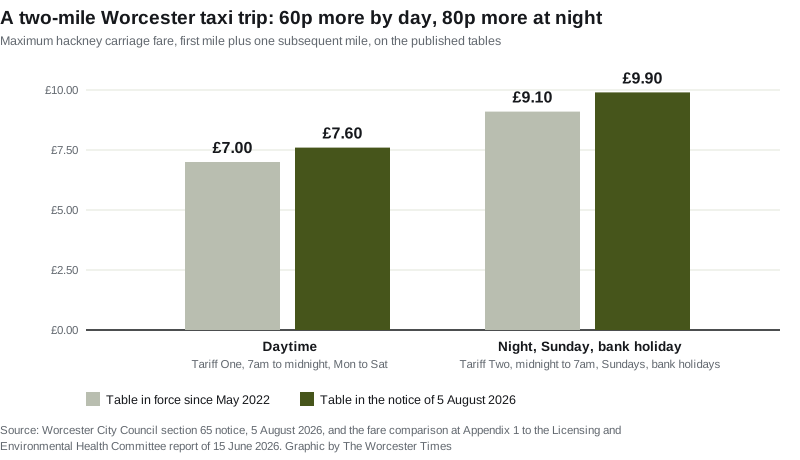
- Daytime, Tariff One: £7.00 becomes £7.60, up 60p.
- Night, Sunday and bank holiday, Tariff Two: £9.10 becomes £9.90, up 80p.
The council’s own benchmarking used Tariff One only. On that £7.00 figure, the report put Worcester 228th of the 358 licensing authorities in the monthly league table kept by the trade paper Private Hire and Taxi Monthly, a little below the middle.
Officers also tested the drivers’ fuel argument and found it only half stood up. In the week the current fares took effect, in May 2022, unleaded averaged 162.48p a litre and diesel 177.06p. When the report was written, unleaded was 158.78p, down 2.28%, while diesel was 185.07p, up 4.52%. Petrol is cheaper than it was. The report leans instead on cumulative UK inflation between 2022 and 2026 of roughly 20% to 22%.
What has not been confirmed
The notice is conditional. It says the new table applies from 20 August “if no objections are received or are received but later withdrawn”. If objections were made and stand, the council must consider them before deciding.
The council has not published whether any objections came in. We could not confirm it today:
worcester.gov.uk returns a JavaScript challenge to automated requests, and Worcestershire
Regulatory Services, which administers licensing for the city, does not publish the fare
table on its site. So we can report what the notice requires, not what has happened since
the window shut.
Two things follow from the record if objections were made.
- Under section 65 of the Local Government (Miscellaneous Provisions) Act 1976, the council must set a further date no later than two months after the first. That would be 20 October 2026 at the latest.
- The committee attached a condition of its own. It delegated the final decision to the Corporate Director for Operations, Homes and Communities, in consultation with the chair and vice-chair. But the resolution adds a caveat: “if there is substantial opposition to the proposal, or if significant new information emerges through the consultation, the proposal will be brought back to the Committee for consideration”.
There was opposition on the record before the consultation even opened. A member of the public told the June meeting that drivers do not want the flag fare raised at all. They want the distance rate cut instead, because affordability and customer demand had become the real problem. The same speaker told members that Wolverhampton-licensed vehicles were using city centre hackney ranks, and that evening and night-time enforcement needed to be stronger. The chair said those views would be taken into account by members when they considered the fares item. A separate report on enforcement is due at the committee’s next meeting on 7 September 2026.
One deadline has already slipped. Officers wrote that they expected every licence holder to have reprogrammed their meters by 1 August 2026. The statutory notice was not published until 5 August, four days after that date, and the fares could not lawfully take effect before 20 August.
What it means for you
These are maximum fares, not fixed ones. The minutes record officers confirming that drivers have discretion to charge less. The meter must never show more than the published table at the end of the journey.
This covers hackney carriages only. Those are the vehicles you can flag down in the street or pick up at a rank. Private hire cars, the ones you have to book in advance, are not covered: operators agree the price with the customer at the time of booking. If you pre-book, this change does not apply to your journey.
Check the fare card. A licensed hackney carriage carries the current table of fares in the vehicle. If the meter and the card disagree, the card is the one to raise.
The night tariff is where the money is. If you mostly use taxis in the daytime, a two-mile trip costs 60p more. If you rely on them after midnight, on a Sunday or on a bank holiday, the same trip costs 80p more, and the flag fare alone is up 90p.
Complaints and objections go to Worcestershire Regulatory Services, not to the city council directly. The notice gives the address as the Licensing and Support Services Manager, Worcester City Council, c/o Worcestershire Regulatory Services, Wyre Forest House, Finepoint Way, Kidderminster DY11 7WF. The contact address published on the fare table itself is enquiries@worcsregservices.gov.uk.
The council’s own report named who it expected this to hit hardest: disabled residents, older residents and families on low incomes who rely on taxis because there is no alternative. Worcester has no permanent park and ride, and the evening bus network thins out early, which is why the tariff matters here more than the size of the increase suggests.
For getting around the city, see our pages on roadworks and travel in Worcester and Worcester train times to London. Council and licensing decisions are tracked on our Worcester planning news page.
We will report the outcome if the council confirms objections were received, or if the proposal returns to the Licensing and Environmental Health Committee.
Update, 3 September 2026: the fares did not take effect on 20 August. Committee papers published for 7 September confirm two objections were received before the deadline, both from the taxi trade, so the variation was suspended. Councillors are asked to bring the new table in from 15 September instead. Read the full follow-up.
Have your say