
Worcester's daytime taxi flag fare would rise from £4.30 to £5.00, taking a two-mile trip to £7.60. What the council's own papers show, and your right to object.
The most a Worcester taxi can charge you to get in would rise from £4.30 to £5.00 under a proposal now sitting with the city council, the first change to the city’s hackney carriage fares in more than four years. (Worcester City Council, Hackney Carriage Table of Fares Review, Licensing and Environmental Health Committee, 15 June 2026)
On the council’s own comparison method, that takes a standard two-mile daytime trip from £7.00 to £7.60.
We read the committee report and the draft fare table attached to it. Two things stand out that have not been reported elsewhere: the draft table does not match what the report’s own text describes, and the deadline officers set for taxi meters to be reprogrammed has already passed without the public getting its say.
What is actually on the table
Worcester last changed its fares on 1 May 2022, under a table approved that March. In May 2026 the Worcester Taxi Association wrote to officers asking for an increase of about 15% to the initial hiring charge, the “flag fare” that appears on the meter before the vehicle moves. The request went to the city’s Taxi Forum on 20 May 2026, where trade representatives settled on raising the flag fare alone, leaving the mileage rate untouched.
The drivers’ case, as recorded in the report, rests on four things: vehicle running costs, annual licence fees, fuel, and the general cost of living.
The draft table of fares attached to the report sets out the change in full.
| Charge | Now (May 2022) | Draft (June 2026) |
|---|---|---|
| First 1,208m (flag fare) | £4.30 | £5.00 |
| Equivalent to, for the first mile | £5.00 | £5.60 |
| Each subsequent mile | £2.00 | £2.00 |
| Waiting time, per 30 seconds | 10p | 10p |
Tariff One runs from 7am to midnight, Monday to Saturday, so it covers almost every ordinary trip into town, to the station or home from the shops.
The extra charges are unchanged: 50p for each passenger beyond the first three, and £75 if a passenger or animal soils the vehicle.
The discrepancy in the council’s papers
The report’s text says both tariffs go up. At paragraph 2.7 it records the trade proposal as raising Tariff One’s flag fare from £4.30 to £5.00 and Tariff Two’s from £5.50 to £6.40, each “a 16% increase rounded down”.
The draft table attached to that same report does not do that. It leaves Tariff Two exactly as it is: £5.50 to hire, £6.30 for the first mile, £2.80 for each mile after. Only Tariff One changes.
Tariff Two is the expensive one, and it covers the times people have least choice about: midnight to 7am Monday to Saturday, all day Sunday, all bank holidays, Christmas Day, Boxing Day and New Year’s Day, and the evenings of Christmas Eve and New Year’s Eve. Whether the £6.40 in the text or the £5.50 in the table is the figure that goes out to consultation makes a real difference to anyone getting home from a night out or working a Sunday shift. The papers as published do not settle it.
How Worcester compares
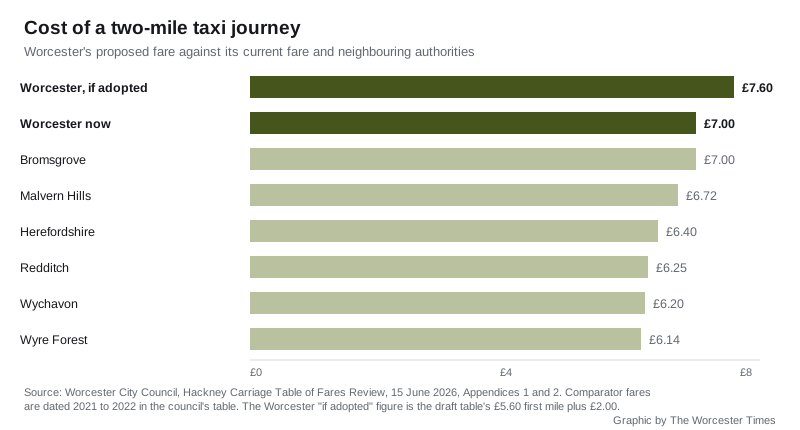
Councils compare taxi fares using the cost of a two-mile journey. Officers put Worcester at £7.00, which is what the published table produces: £5.00 for the first mile plus £2.00 for the second. Applying the same arithmetic to the draft table gives £7.60.
That £7.00 currently places Worcester 228th out of the 358 licensing authorities in the national league table kept by the trade paper Private Hire and Taxi Monthly, so a little below the middle.
| Authority | Two-mile fare |
|---|---|
| Worcester, if the draft is adopted | £7.60 |
| Worcester now (May 2022) | £7.00 |
| Bromsgrove District Council | £7.00 |
| Malvern Hills District Council (July 2022) | £6.72 |
| County of Herefordshire (Nov 2021) | £6.40 |
| Redditch Borough Council (May 2022) | £6.25 |
| Wychavon District Council (May 2022) | £6.20 |
| Wyre Forest District Council (April 2022) | £6.14 |
Every comparator above except the draft Worcester figure comes from the council’s own appendix, with the dates it gives. Several are four or five years old, so the gap to Worcester’s neighbours is probably narrower in practice than the table suggests.
At £7.60 Worcester would sit level with Birmingham and Solihull, both listed at £7.60, and above Tewkesbury at £7.40. Shropshire tops the comparison at £8.00.
The fuel argument, checked
The report puts the drivers’ fuel case to the test and finds it only half holds up. Using weekly government fuel price data, it records that in the week beginning 2 May 2022, when the current fares took effect, unleaded averaged 162.48p a litre and diesel 177.06p. When the report was written, unleaded was 158.78p, down 2.28%, while diesel was 185.07p, up 4.52%.
So petrol is cheaper than it was when the current fares were set. Officers point instead to the broader figure: cumulative UK inflation between 2022 and 2026 of roughly 20% to 22%, measured on the Consumer Prices Index. On that measure a 16% rise still leaves drivers behind where they were in 2022.
Where the decision now stands
Committee members were asked to note the request, instruct officers to begin the statutory consultation, and hand the final decision to the Corporate Director for Operations, Homes and Communities, in consultation with the committee’s chair and vice-chair.
The law sets out what has to happen next. Under section 65 of the Local Government (Miscellaneous Provisions) Act 1976, before any new table of fares can take effect the council must publish a notice in at least one local newspaper setting out the change and giving the public no fewer than 14 days to object. A copy has to sit at the council offices for those 14 days, open to inspection free of charge. If nobody objects, the new fares start when the period ends. If objections are made and not withdrawn, the council must set a further date, no later than two months after the first one, and can adopt the table with or without changes once it has considered what people said.
Officers wrote that they expected every licence holder to have reprogrammed their meters by 1 August 2026 if the increase was approved. That date has gone.
Update, 20 August 2026. The statutory notice had in fact been published on 5 August 2026, before this article first appeared, and our search of the Public Notice Portal on 13 August did not find it. Objections closed on 19 August and the new table is due to take effect on 20 August. The notice raises both tariffs, so the Tariff Two question below is settled: it follows the report’s text, not the draft table. The minutes of the 15 June meeting have also since been published. Our full report is here: Worcester taxi fares due to rise today.
What it means for you
If you use a Worcester taxi, nothing has changed yet. The meter in a licensed hackney carriage must show no more than the published table, and that table is still the May 2022 one until the statutory notice has run its course. If a meter charges you a £5.00 flag fare before then, that is not the approved fare.
Three practical points worth knowing.
This only covers hackney carriages. These are the vehicles you can flag down or pick up at a rank. Private hire cars, the ones you have to book in advance, are not covered by the council’s table at all: the report is explicit that private hire operators agree the price with the customer when the booking is made. If the increase goes through, pre-booked journeys are unaffected by it.
Nights and Sundays may not change. On the draft table as published, Tariff Two stays at £5.50. On the report’s text it goes to £6.40. Watch which version appears in the statutory notice, because that is the one that counts.
You get 14 days, and the council has to tell you how to use them. The objection period only opens when the notice is published in a local paper. The notice itself must specify the manner in which objections can be made. Licensing for Worcester is administered by Worcestershire Regulatory Services, whose published contact address on the fare table is enquiries@worcsregservices.gov.uk. The council’s own risk assessment names the people it expects to be hit hardest: disabled residents, older residents and families on low incomes who rely on taxis because there is no alternative.
Worcester has no permanent park and ride, and the city’s evening bus network thins out early, which is part of why the taxi tariff matters more here than the size of the increase suggests. For getting around the city more generally, see our guides to roadworks and travel in Worcester and Worcester train times to London. Planning and licensing decisions are tracked on our Worcester planning news page.
We reported the statutory notice when it appeared, with the exact figures and the deadline: Worcester taxi fares due to rise today, and the night fare goes up too.
Have your say