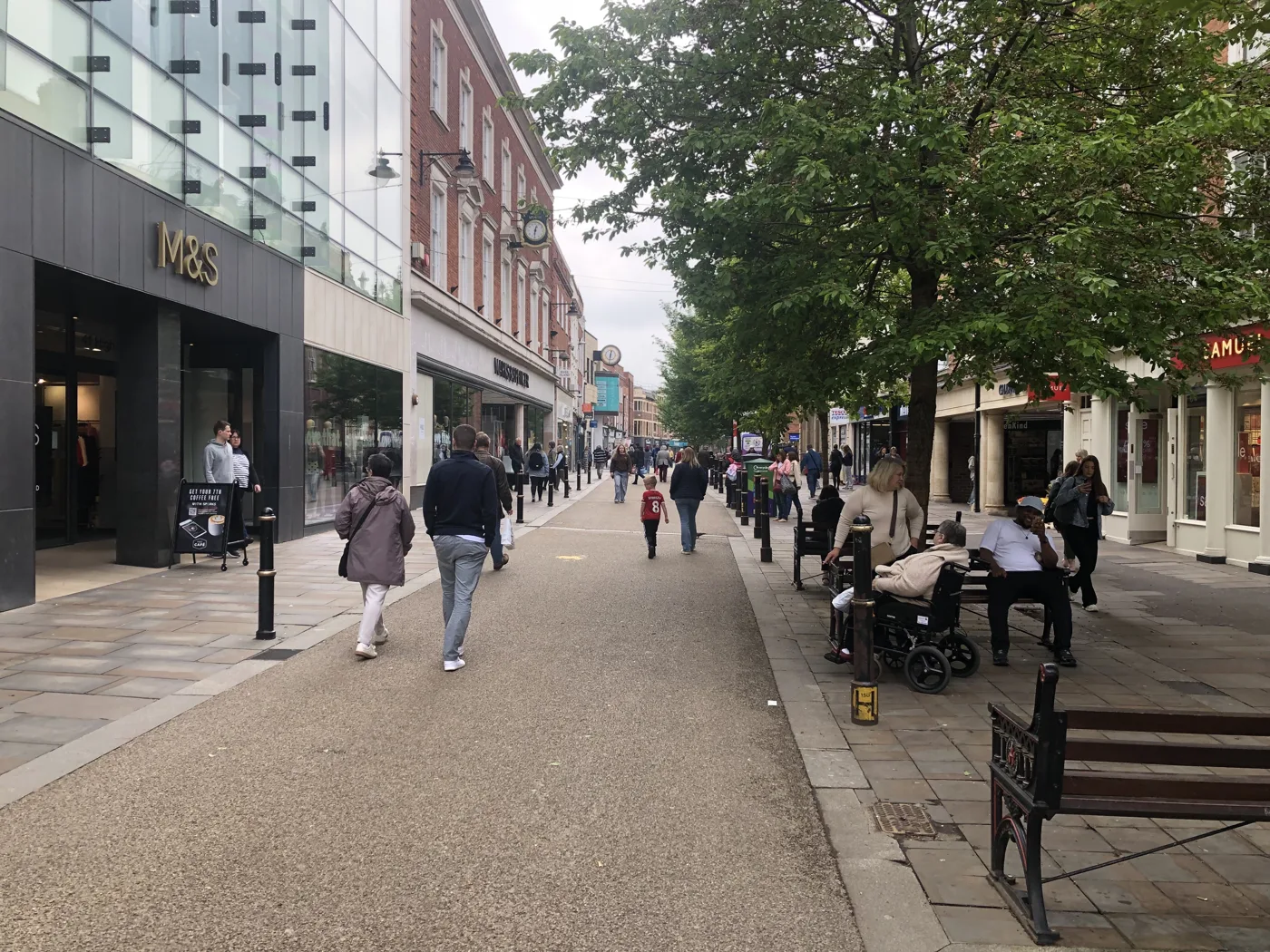

Councillors voted on Tuesday to ask the county to examine letting cycles through the 11 banned streets, after the 12-month trial condition was stripped out.
Worcester city councillors voted on Tuesday night to ask the county council to examine letting people cycle through the city centre streets where it is banned between 10am and 6pm. The motion was carried, but only after a substantial amendment stripped out the 12-month trial, the consultation and the commitment to publish the evidence.
The push has something behind it that it has not had before. The county’s Cabinet Member for Highways wrote to the city council’s Managing Director the day before the meeting, saying it may now be appropriate to reconsider the restrictions and asking for the city’s view before the county considers the matter further.
The council has not yet published the minutes, and on this council they are only published once the next meeting approves them. The account of the debate and the vote below therefore comes from the council’s own recording of the meeting, published on its committee site. (Council, 15 September 2026, Worcester City Council)
What the ban actually is
The restriction is a traffic regulation order made by Worcestershire County Council, which is the highway authority. A pedal cycle counts as a vehicle for the purposes of the order, so cycling in the zone during the core hours is prohibited in the same way driving is.
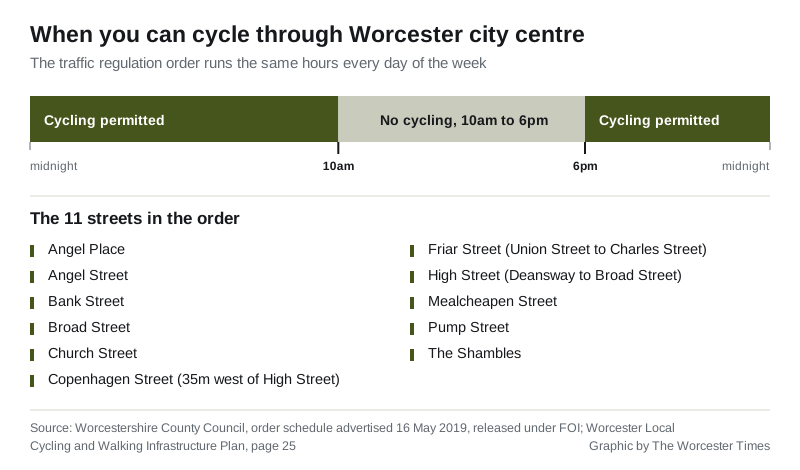
The core period runs 10am to 6pm, every day of the week. Outside those hours a wider set of exemptions applies, including loading and unloading and pedal cycles. In the county’s own words in its 2026 walking and cycling plan, the order “only permits access by cyclists and loading vehicles to between 6pm and 10am”. (Worcester Local Cycling and Walking Infrastructure Plan, page 25)
The schedule the county advertised in May 2019 covers eleven streets:
- Angel Place, entire length
- Angel Street, entire length
- Bank Street, entire length
- Broad Street, entire length
- Church Street, entire length
- Copenhagen Street, 35 metres west of High Street
- Friar Street, from Union Street to Charles Street
- High Street, from 32 metres north of Deansway to Broad Street
- Mealcheapen Street, entire length
- Pump Street, entire length
- The Shambles, entire length
A separate order bans all vehicles from the first 32 metres of High Street north of Deansway at all times. That short length is not affected by the hours.
Where the ban came from
The zone is older than most people assume. The county’s report on the 2019 change says the original access restrictions, which ran 10.30am to 4.30pm, “were introduced in 1990 following a public inquiry”.
In 2019 the county proposed widening the core period to 10am to 6pm. The stated aim was highway safety, and the report is blunt about what the change would do to cyclists. It says the proposal “will achieve this by extending the period during which motor vehicles and pedal cycles are excluded from the zone and thereby reduce the potential for conflict with pedestrians”. (Worcester City Centre Pedestrianised Zone, proposed amendment to hours of operation, 16 May 2019, released by Worcestershire County Council under FOI)
Two things in that report are worth carrying forward, because they explain why the argument keeps coming back.
Nobody routinely enforces it. A prohibition of driving order is a moving traffic offence and enforcement is a police responsibility. The force’s traffic management advisor, replying on behalf of the Chief Constable, said the police would offer no objection “on the understanding that there will be no additional expectations on the Police to provide any enforcement activities in the Pedestrian Zone”. The county’s own conclusion notes that enforcement “has not formed part of their routine duties for many years”.
The signs were already old. The report describes the existing signs as “nearly 30 years old now and in need of replacement”, and concedes that the access rules are “quite complicated and that will inevitably be reflected in the signs”.
The motion as it was tabled, and what survived
Motion 3 was proposed by Councillor Tor Pingree, the Green member for St Clement, who is also the city’s current Mayor, and seconded by Councillor Hannah Cooper. (Notice of Motion, Council, 15 September 2026, Worcester City Council and Councillor Tor Pingree)
As published a week before the meeting, it had two parts:
- write to the county’s Cabinet Member for Highways within 28 days, asking for a joint examination of options, including the feasibility of allowing cycling through all restricted areas in the city centre
- refer to the city’s Place and Economic Development Committee a full consultation with disability, older people’s and cycling organisations, a request that any trial run for at least 12 months and gather collision and near miss evidence, and a commitment to publish the monitoring data in full
Part 2 is gone. The chair of that committee, Councillor Adrian Gregson, moved an amendment deleting the whole of it, and told the meeting he had not been consulted about it. His case was that the county, not the city, would have to run the statutory consultation, and that his committee’s agendas for the next six months are already taken up with economic investment, culture and heritage projects, the markets and the Angel Place development. (Place and Economic Development Committee membership, Worcester City Council)
Deleting a whole paragraph counts as a substantive amendment under the council’s recently changed constitution, which allows any two members to call an adjournment to consider one. Two did. The meeting broke for ten minutes.
The proposer then accepted the deletion, with one addition of her own to part 1: that once the feasibility review is complete, a report comes back to the relevant committee for review and feedback. That became the substantive motion, and it was carried on a show of hands. A named vote was suggested and not pressed.
So the council has asked for the review and for a report back. It has not, as a council, committed to a consultation, to a minimum trial length, or to publishing the evidence.
The letter from County Hall
The change of tone at the county is the part of this that is genuinely new. The city council’s Managing Director received a letter from Worcestershire’s Cabinet Member for Highways in the days before the meeting. Sections of it were read into the debate.
The letter says that given the level of public interest and the passage of time since the current arrangements were introduced, it may be appropriate to reconsider the existing restrictions. It goes on to say that in advance of any further consideration by the county, the Cabinet Member wants to understand the views of the city council, that decisions of this kind are best informed by those closest to the communities affected, and that he would welcome a clear indication of members’ views once they had considered the motion.
The portfolio is held by Councillor Tom Wells, an Independent. (Our Leader of the Council and Cabinet Members, Worcestershire County Council) The letter itself has not been published on either council’s website.
The case against, as it was put
The motion was not carried without opposition. The council’s Reform UK member argued that a pedestrianised centre exists precisely to be free of moving vehicles of every kind, that a cyclist can dismount and push a bike the length of the High Street, and that the real problem is the absence of any enforcement rather than the hours. He also argued that both this motion and the one before it concern matters that belong to the county council.
Several members who spoke in favour said they had arrived intending to vote against the motion as originally drafted, and that the amendment changed their position. Concerns raised from more than one group were the same ones the motion itself acknowledges: that blind and partially sighted people, wheelchair users, older people and people with dementia can find shared space difficult, and that those groups are less organised than cycling campaigners.
The plan the motion points at does not go through the centre
The motion asks the county to look at permitting cycling “using the routes proposed as part of the Local Cycling and Walking Infrastructure Plan”. That plan was published on 2 September and we went through it in detail when it landed: thirteen schemes, £88m, and no funding attached.
Read against the eleven restricted streets, the plan does not do what the motion implies it might. None of its twelve cycle routes runs along any of the eleven restricted streets.
Route J, the plan’s only city centre cycle scheme, is a loop. It circles the pedestrian core rather than crossing it, on Bridge Street, Worcester Bridge, North Parade, Croft Road, Castle Street, Foregate Street, The Butts, Sansome Street, City Walls Road and Lowesmoor.
The restricted streets appear in the plan only in its core walking zone chapter, as public realm work. So a cyclist following the county’s own plan from Foregate Street to the Cathedral would still go around the outside. That is the gap the motion is aimed at.
What happens next
- By 13 October, 28 days from the meeting, the Managing Director writes to the county’s Cabinet Member for Highways asking for the joint examination of options.
- After that review, a report comes back to the relevant city committee, under the sentence added on the night. No date is fixed for it.
- Any change to the order itself is a county decision. A traffic regulation order has to be advertised and objections considered before it can be made or revoked, and an objection that cannot be resolved can trigger a public inquiry, as the original restrictions did in 1990.
What it means for you
The ban still applies today. Cycling through the eleven streets between 10am and 6pm is still prohibited. Before 10am and after 6pm it is permitted. Tuesday’s vote changes nothing on the ground, and nothing will change quickly.
The city council cannot lift it. The decision maker is Worcestershire County Council. What the city has done is send it a view, which is what the county asked for.
There is no consultation open. The consultation the motion originally promised was the part that was removed. If the county runs one as part of its own review, it will have to advertise it. We will report it when it does.
If you drive or park in the centre, the same order is what keeps motor traffic out between 10am and 6pm, and the exemptions for market vehicles and servicing sit inside it. Our parking in Worcester page covers the car parks around the zone, and Worcester roadworks and travel has the current closures.
Sources
- Notice of Motion, Council, 15 September 2026, Worcester City Council
- Agenda and webcast, Council, 15 September 2026, Worcester City Council
- Worcester City Centre Pedestrianised Zone, proposed amendment to hours of operation, 16 May 2019, Worcestershire County Council, released under FOI
- Worcester Local Cycling and Walking Infrastructure Plan, Worcestershire County Council, August 2026
- Our Leader of the Council and Cabinet Members, Worcestershire County Council
- Place and Economic Development Committee, Worcester City Council
The debate, the amendment and the result are taken from the council’s own video recording of the meeting of 15 September 2026, linked from the agenda page above. Minutes had not been published when this was written.
Have your say