
From 31 October a Worcester councillor can no longer send a planning application to committee. The council's own report sets out what replaces it, and your 10 days to act.
From 31 October, a Worcester city councillor will no longer be able to send a planning application to the Planning Committee. The automatic right of referral, the thing most residents mean when they ask their councillor to “call it in”, is being abolished by law, and the city council has told its own committee that the arrangements will have to come out of the constitution. (Worcester City Council, National Scheme of Delegation, report to Planning Committee, 13 August 2026)
The report went to the committee four days ago. It is a “note” item rather than a decision, and the binding vote comes later: a separate report goes to full Council on 15 September 2026 seeking the constitutional changes needed before the deadline.
What actually changes
The National Scheme of Delegation comes from section 54 of the Planning and Infrastructure Act 2025, delivered through the Town and Country Planning (Discharge of Local Planning Authority Functions) (England) Regulations 2026, made on 15 July 2026. It splits every application into two boxes.
Schedule 1 must be decided by an officer. No committee, no exceptions. Worcester’s report lists what falls in: householder development, minor residential development “generally involving up to nine dwellings on sites below 0.5 hectares”, minor commercial development, most reserved matters, discharge of conditions, prior approvals, non-material amendments, certificates of lawfulness and biodiversity gain plans.
Schedule 2 is everything else, including listed building consent, advertisement consent and works to protected trees. These can still reach committee, but only through a new process, and only if two named people agree.
The council is blunt about the consequence of getting it wrong. If an application that must be delegated is instead determined by Planning Committee, the report says, “the decision could be vulnerable to legal challenge and may be quashed”.
What this would have stopped in Worcester
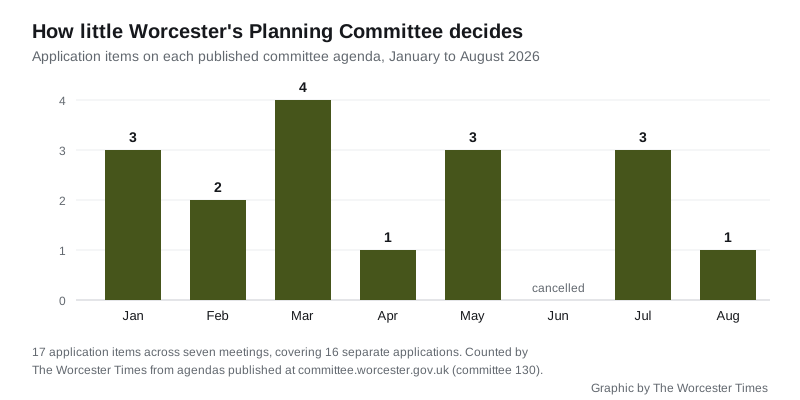
Worcester’s Planning Committee is not a busy one. We counted the application items on every agenda the council published for the committee in 2026: eight meetings were scheduled, one was cancelled, and across the rest the committee handled 17 application items covering 16 separate applications. That is roughly two a month.
| Meeting | Application items |
|---|---|
| 22 January | 3 |
| 12 February | 2 |
| 19 March | 4 |
| 16 April | 1 |
| 21 May | 3 |
| 18 June | cancelled |
| 23 July | 3 |
| 13 August | 1 |
At least two of those 16 could not have gone to committee at all under the new rules.
On 19 March the committee considered application 24/00656/HP at 10 Perrywood Walk. The “HP” suffix is a householder application: Schedule 1, officer decision only, from 31 October.
On 22 January it considered 25/00988/PIP, land to the rear of 14 to 20 Barbourne Road. “PIP” is permission in principle, which the council’s own report names in its list of Schedule 1 categories.
Most of the rest were listed building consents, several of them at The Commandery on Sidbury. Those sit in Schedule 2, so they could still be referred, but only through the new gateway rather than because a councillor asked.
The gateway that replaces call-in
A Schedule 2 application can only go to committee if it raises one or both of two things, set out in regulation 5: an economic, social or environmental issue “of significance to the local area”, or a significant planning matter having regard to the development plan.
Meeting that test is not enough on its own. The referral must then be agreed by a Nominated Officer and a Nominated Councillor. Worcester proposes the Head of Planning and Economic Development for the first role and the Chair of Planning Committee, or the Vice Chair in their absence, for the second. If the two of them cannot agree, the report is explicit: “the application will remain delegated to officers”.
The council has drawn up a local triage process, attached to the report as an appendix. The Service Manager for Development Management reviews the weekly list of new applications, pulls out the Schedule 2 ones, and circulates a triage list to those two people. A triage meeting is held, generally in the last week of each month, with legal services present and minutes taken. Each case ends in one of three recorded outcomes: report it to committee, determine it under delegated powers, or defer it to a future triage meeting for more information. The reasons have to be recorded against the regulation 5 criteria.
The report also notes that the regulations cap a planning committee at 13 members. Worcester is already within that, so its committee does not shrink.
Councillors were briefed on all this at an all-member session on 4 August 2026, with another scheduled for 3 September.
What it means for you
If you object to a planning application in Worcester, the way you do it is about to change, and the window is tighter than the old one.
Asking your ward councillor to call it in stops working. The report is direct: “there will no longer be an automatic right for a councillor to refer an application for consideration by Planning Committee”. Councillors can still raise issues and represent concerns, and the council acknowledges it will have to manage expectations about that.
Your objection to the officer becomes the main event. Because officers will decide almost everything, a well-argued written objection sent to the planning department now carries more weight than lobbying a councillor does. Stick to planning grounds: the development plan, highways, amenity, heritage, drainage. Matters that were never material considerations still are not.
If you want a case referred, ten days is the clock. Under the proposed triage process, ward members who think an application should go to committee submit representations to the Service Manager for Development Management within 10 days of the weekly list being published, and relevant cases are identified within 14 days of an application being made valid. If you want your councillor to make that argument, they need your reasons inside that window, not a month later when the decision notice lands.
Watch 15 September. That is when full Council is due to approve the constitutional changes. Council meetings are held in public and the agenda is published in advance on the council’s committee site.
Small schemes near you will be decided quietly. An extension next door, a change of use on the parade, nine flats on a small site: none of those can be argued out in a public committee meeting from 31 October, however many objections they attract. The place to influence them is the case officer, during the consultation period.
Worcester City Council’s planning register is at plan.worcester.gov.uk, and we track decisions on our Worcester planning news page. For the wider context, the city merges with Malvern Hills and Wychavon into a new South Worcestershire unitary authority in April 2028, so these arrangements will be inherited by a council that does not exist yet.
We will report what Council decides on 15 September, including the final wording of the referral rules.
Update, 17 September 2026: this article describes Worcestershire’s reorganisation as decided in July 2026. On 7 September the government paused those decisions while it reviews the programme, and said May 2027 elections will go ahead to existing council boundaries. The 1 April 2028 date is now under review. Our report has the detail.
Have your say